


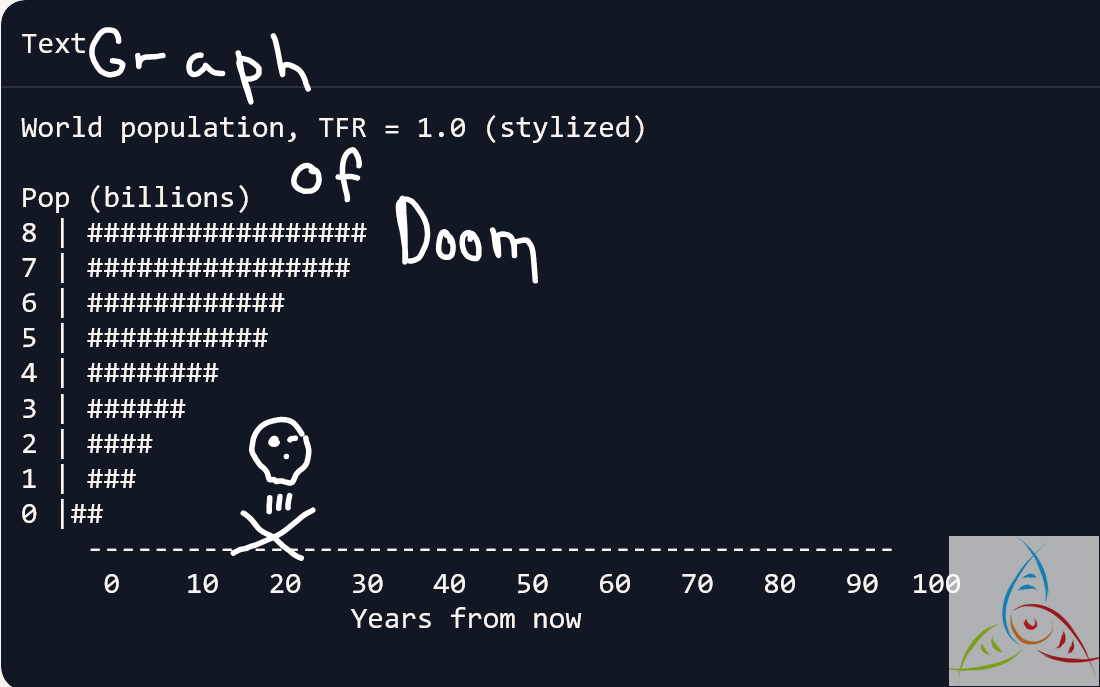
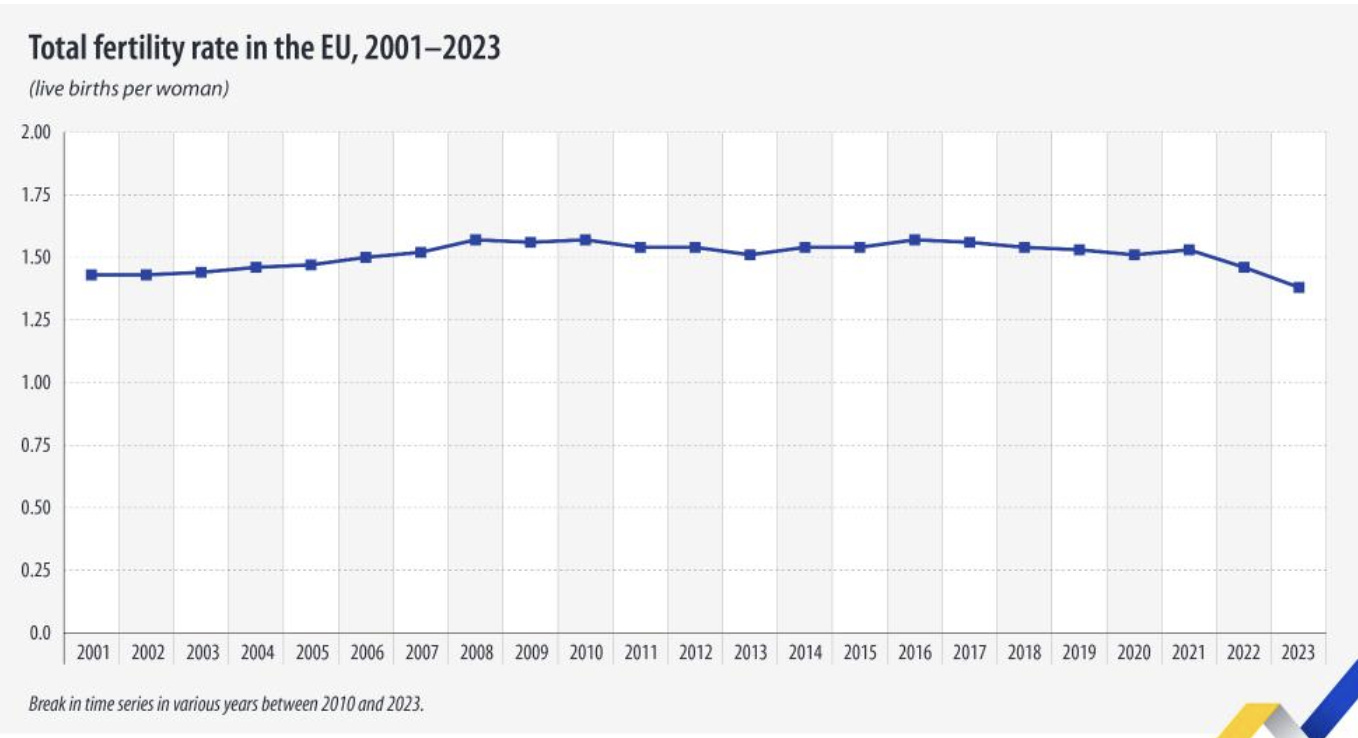
I recently posted on the steep, global, and apparently irreversible, decline in religious faith and observance focusing on Iran and Islam, and extending it as a global truth about Christianity and Judaism also. There is a very strong correlation, in the decline of religious observance and the decline in the birth rate, that is, the Total Fertility Rate (TFR). TFR is the number of live births, per woman, per lifetime, on average for a cohort. A TFR of 2.1 is needed to replace the population, assuming a steady death rate. The current, global TFR is 2.2, that is down from a TFR of ~5 in 1950, seventy-five years ago. The global 2.2 TFR is derived from averaging high African birthrates with the rest of the world which is low and very low. Low enough we need to graph out the roadmap where we are heading. Actually, it's more like a forced landing. The engine is out and we are descending. There is no runway. It's not a good situation.
Start with South Korea, which currently has the distinction of the lowest TFR in the world at 0.68. South Koreans also have an average age of 45, one of the oldest median ages among the nations. Right now, just ten percent of South Koreans are younger than sixteen. South Korea has a current population of 51 million. If we run the TFR of 0.7 out twenty-five years - factoring in no immigration, South Korea in 2050 will have a population of only 33 million, and a median age of around fifty-six. Twenty million fewer South Koreans in twenty-some years and over forty percent of the remaining population older than age sixty-five. With the stabilized median age of 55 by 2050, the theoretical halving of the remaining South Korean population at that TFR of .7 is only nineteen years. In 2070 South Korea will have reduced its population to 15 million people from 51 million over the course of the forty-five years - if… the TFR stays at 0.7
Japan, which has a current TFR of 1.22, and has had a <2.1 TFR since the mid 70s has the oldest median age of any nation, 49.8 years. Japan’s population has been declining since 2008. Rural Japan is in structural collapse. Schools, hospitals, transport have closed. The population of rural Japan as a percentage of the entire population has declined from 35% in 1960 to less than 8% in 2020 and the median age in rural areas is five to ten years older than the already record high age of 49.8. There are places in rural Japan that will give you land and a house if you will move there. The people put up scarecrows to help with the loneliness
Japan’s TFR of 1.22 is way better than South Korea’s 0.7 TFR right? There isn’t much difference once the median age stabilizes around fifty-six. Instead of taking nineteen years to halve the Japanese population like in Korea, it will take twenty-five. Before we move on to China, and the Chinese are going to reap the grimmest demographic harvest, a word about North Korea. North Korea makes up their statistics - they are unreliable. But their published TFR of 1.8 is probably realistic. The reason is the rural population of North Korea is still high at 35%. South Korea’s rural population (<20%) is just like Japan’s - very old and in structural collapse.
China, because it has such a large population, is heading into interesting times. China has achieved the goal: One-child-per-family. China’s TFR is at 1. If China maintains a TFR of 1 for the next one hundred years, its population will decline from 1.48 billion people to around 120 million. One hundred and twenty million is 8% of 1.48 billion.
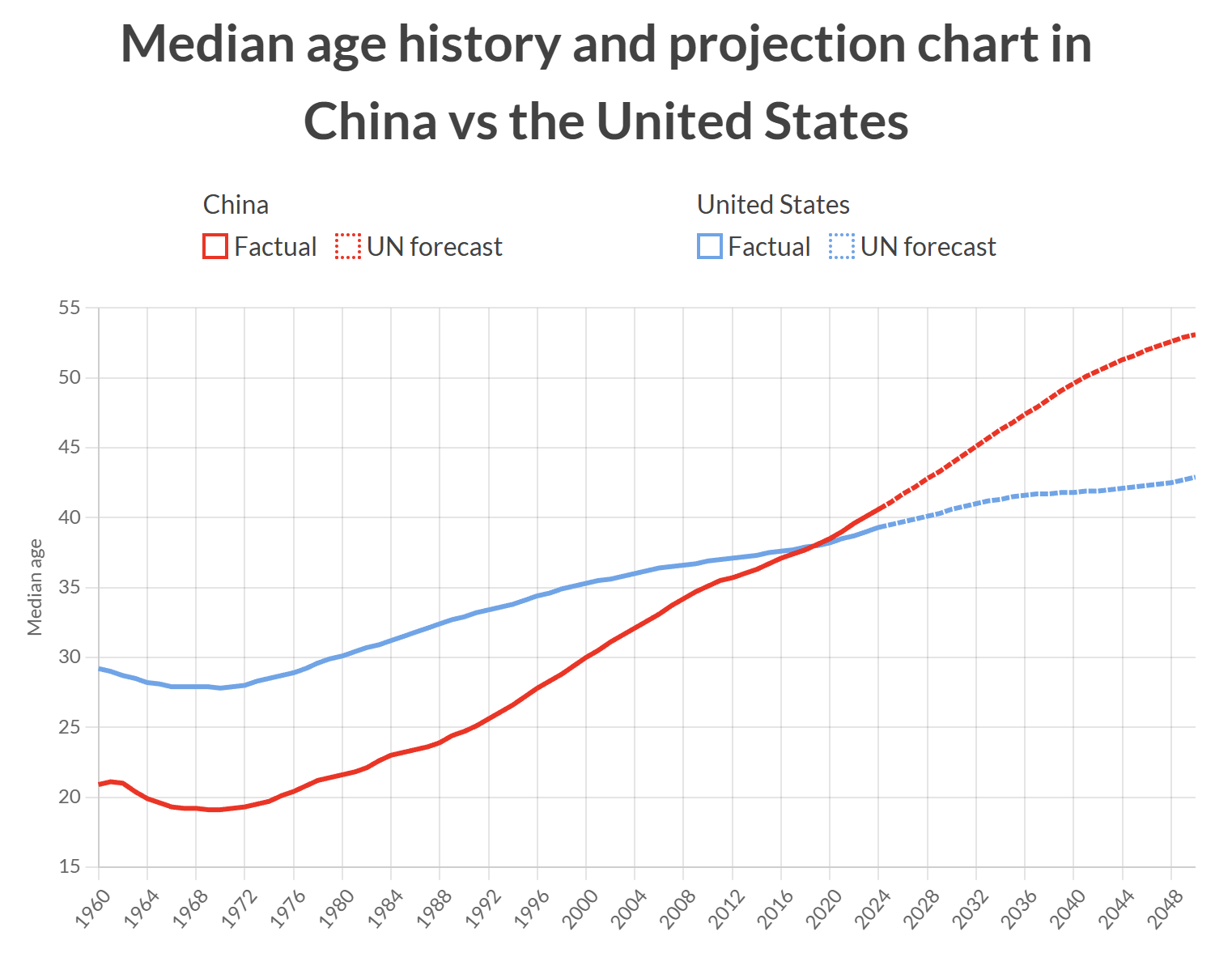
The United States has a TFR of 1.62. If you do the math and run out the population/TFR numbers one hundred years for the US maintaining the TFR at 1.62, our population will drop from ~335 million to ~150 million. Long before you get to the end of the one hundred years, the median age for both China and the US would be plateaued at ~56.

Paul Ehrlich’s book, The Population Bomb, was published in 1968. It was the wrongest book ever. But no one (almost no one) believed it was wrong at the time. World population was rising and the all the poor people were going starve, but not before they destroyed the environment and ran us out of everything. Such thinking was behind the US foreign policy enforcement of population control and China’s-One-Child-per-Family rule.
Ben Wattenberg’s book, The Birth Dearth, was published in 1987. Wattenberg picked up early the depopulation trends that were developing and are so obvious today. Wattenberg stated those trends were not going to reverse themselves. He was right about the trends, but he was universally panned as an alarmist and a conservative partisan. After all, they said he was blaming it all on women.
I don’t ‘blame’ anybody for the birth dearth. I don’t think Ben Wattenberg did either. Wattenberg understood low birth rates had to do with the changing economy and that’s also why he thought the problem would prove to be intractable. Family economy, home economics, if you will, are globally very different from the past. All we do by hand these days is put the frozen pizza in the oven. You have read the statistics, now listen to the story.
My Dad wrote no books, but he sure knew a lot. He was born in 1934. The TFR was ~2.3 that year. He told me that when he was growing up, “We had no idea how poor we were.” His family was prosperous and if not well-to-do, better off than most. I want to statistically take a snapshot of US wealth and wealth creation in 1934. To justify my father’s observation about their perceptions:
In 1934
The US was the industrial powerhouse of the world, outproducing its nearest competitor by a factor of two (Germany or Great Britian).
80% of the US population lived outside urban centers with a population greater than 100,000 people
50% of the population was dependent on agriculture for their living. 25% directly dependent on farm work.
$1300 dollars a year - average household income = <$30,000 in 2025 dollars.
All the corn was picked by hand - Cornhusker Nation.
All the livestock was fed by hand.
All the coal was mined by hand
All the track was laid by hand - and the locomotives had no digital controls.
Cars, planes, radios, roads, Portland cement, electrification, all pointed to widespread growing prosperity and wealth - 1934, the driest, hottest year of the century (US), in the deepest trough of the worst Depression… People didn’t know how poor they were.
I live in Nebraska. In 1856 the white population of Nebraska was ~2,500. By 1896, forty years later, Nebraska had a population of over one million people. The whole state was covered with productive farms, towns and railways. The wealth that drew all those people to Nebraska was land. And the wealth was extracted year by year from the land by the sweat of men’s brows. Their wealth was their produce. Families weren’t optional - they were the lynchpin of existence, identity, purpose and understanding. Families have always been, and are by definition, productive economic units. Their production always preceded their consumption. My Nebraska example shows, given the right incentives and opportunities, family units can produce a lot. I was reminded recently that Tocqueville said, in his Democracy in America, “The Frontiersman took an ax, the bible, and some newspapers into the wilderness.” He also took his wife and children.
I want to turn my father’s words upside-down. I want to say, “we have no idea how rich we are.” The family unit has lost all its productive function. The members of the family are autonomously productive outside the context of “home economics.” This is something new under the sun. It is only possible because of the tremendous shift of labor from our bodies to our machines. Machine labor is our new wealth, it's not due to any increase in manual productivity. By mastering matter and making machines that are useful to us, we have opened again Pandora's box, and there is no way to put the Jin back in the bottle. This change was well under way when my father was born. The ancient rhythm of life is family, and economics has always been first, home economics. It’s always been about the works of your hands in the context of home. The, “be fruitful and multiply” was, a priori, a part of marriage and family, which is how we made a living and learned how to live. Being fruitful and multiplying is now globally optional. Home economics is obsolete.
Guess what? Home economics is pretty sacrificial. Everybody has to sacrifice and produce or there is no produce. Home economics is about somebody putting the food in the pot and the roof over our heads. Somebody has to bake those buns in the oven. Consumption on the other hand is the opposite of sacrifice. One does not consume one’s children. Bringing children into the world is, a priori, sacrificial. My youngest daughter is past her due date. I am reminded once again of the biological necessity of a pregnant woman living sacrificially to bring a child into the world. The rhythm of life in this new age of the world is about what we will consume, not about what we will produce. That new rhythm is not in tune with sacrifice. For the first time in history, it’s pretty easy for a girl to say, “I’d rather not.” Say what you will about religion, there isn’t much meaning left in our religion if you get rid of sacrifice.
The decline in religious practice seems to me inevitable. Religion helps you make sense of sacrifice, by faith we see the evidence of the things hoped for, the certainty of what is not seen. That child of promise is at our center and inside our deepest desires. We understand the child of promise through religion. You only secure that type of hope by way of sacrifice. There is no other way. Not intentionally, but accidentally, we have made family life optional and home economics metaphorical. I’m afraid an awful lot of people are saying, “I’d rather not.”
In the US we see our politics on fire over immigration and inequality, but we avert our eyes from the Doom Graph. We imagine all sorts of reasons for our political unhappiness and tensions and forget Aristotle told us the truth when he said, “Politics begins with family.” We naturally form governments, because we naturally form families. The household is at the foundation of everything. When we quit forming families, nothing else matters. There will be no soldiers to pay.
I have chosen not to belabor the obvious economic crisis that will attend our declining populations; I think our global economic crisis is a priori. I see the crashing TFR as a slow-motion spiritual crisis subsuming every other crisis in itself. Trying to understand politics, economics, or demographics apart from the new paradigm of autonomous consumption, nulla familia, is simply a waste of time. All the old paradigms are broken.
I will close by pointing out Israel is an outlier with a TFR of 3. The Orthodox are poppin’ ‘em out at TFR 6. Indeed, our only hope is more babies, in the context of families, mothers, and fathers. Aldus Huxley imagined a Brave New World where the context of family could be escaped. Where babies have nothing to do with families. God forbid we end up there.
William, why is it that you see the decline of religion as unavoidable ? I don't understand.
Thinking back to the Schumer-attributed phrase," Demographics are destiny ", makes one wonder why they are so intent upon killing we useless eaters, when The Science shows we're heading there regardless.